
Industrial Engineering · Aluminum Domes · Storage Tanks
Aluminum Domes for Industrial Storage Tanks: Design, Benefits and Retrofit Considerations
Industrial storage facilities need roofing systems capable of protecting stored products, withstanding environmental conditions and supporting reliable long-term operation. For petroleum terminals, chemical plants and other large-scale storage installations, roof design can influence structural performance, maintenance requirements and the management of evaporative emissions.
Aluminum domes have become an established engineering solution for covering industrial storage tanks. Their lightweight, triangulated structures provide a permanent overhead enclosure without necessarily requiring internal support columns.
However, selecting an aluminum dome involves more than choosing a corrosion-resistant material. Engineers must evaluate the existing tank structure, environmental loads, ventilation, product compatibility and the interaction between the dome and other tank equipment.
Understanding these considerations is essential for organizations planning new storage facilities or upgrading existing infrastructure.
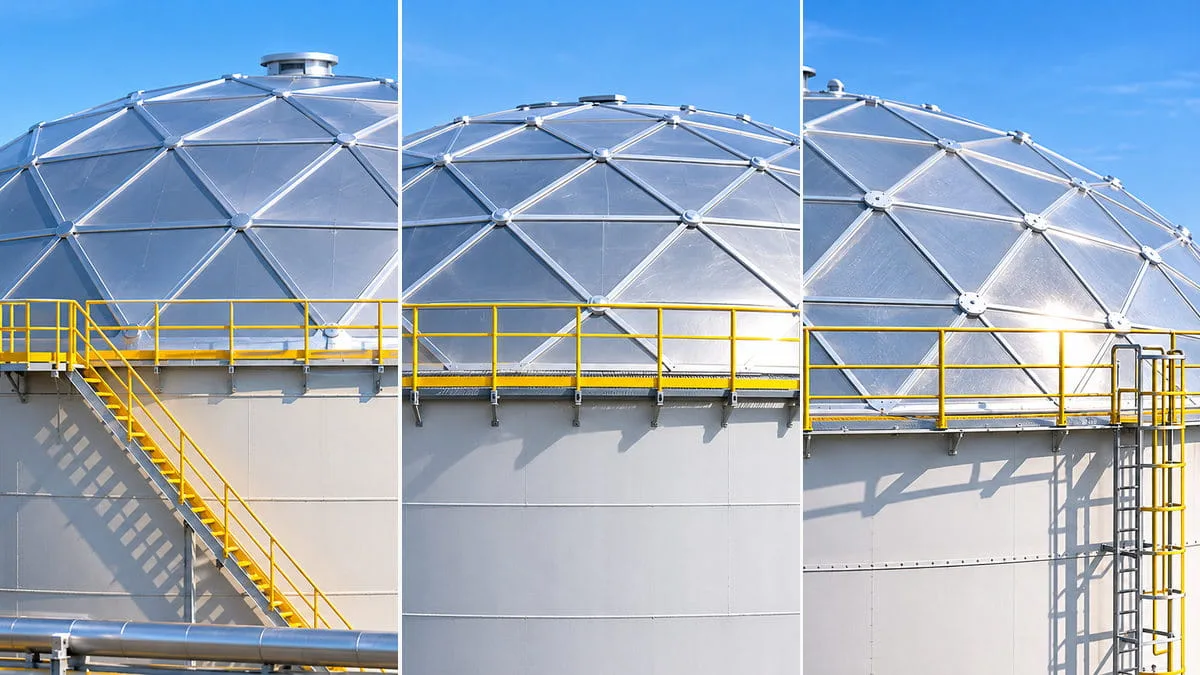
What are aluminum domes for storage tanks?
Aluminum domes are lightweight, self-supporting roof structures used to cover industrial storage tanks. They typically use a triangulated aluminum framework with attached panels to create a protective enclosure.
Aluminum geodesic domes can be designed for suitable new or existing tanks and may complement internal floating roofs to manage weather exposure and certain vapor-loss mechanisms.
Structural compatibility, ventilation and applicable engineering standards must be assessed for each installation.
What Are Aluminum Domes for Storage Tanks?
Aluminum domes are lightweight, self-supporting roof structures used to cover industrial storage tanks. They typically consist of a triangulated aluminum framework and attached roof panels that form a curved protective enclosure.
These structures are commonly known as aluminum geodesic domes or geodesic aluminum dome roofs.
Unlike some conventional fixed roofs, which require internal columns or supporting structures, a properly engineered geodesic dome can transfer its loads to the tank perimeter.
The result is a clear-span roof that leaves the interior of the tank unobstructed by roof-support columns.
How Does an Aluminum Geodesic Dome Work?
The structural principle is based on triangulation.
An aluminum geodesic dome uses interconnected beams arranged into a network of triangular elements. These distribute forces through the structure and toward the supporting perimeter.
The curved geometry provides an efficient way to span large circular openings while controlling structural weight.
Aluminum panels are attached to the framework to form the external roof surface.
The complete design must consider the transfer of loads from the dome to the tank shell and its foundations.
Main Components of an Aluminum Dome Roof
Although configurations vary, a typical industrial aluminum dome includes:
- Structural aluminum beams: interconnected members forming the triangulated framework.
- Connection nodes: components that join the structural members.
- Roof panels: aluminum sheets that provide the external protective surface.
- Perimeter supports: connections that transfer dome loads to the tank.
- Sealing and fastening elements: components designed to maintain the integrity of panel joints and attachments.
- Roof accessories: access openings, vents and other equipment required by the project.
Each component must be compatible with the intended service and the applicable structural specification.
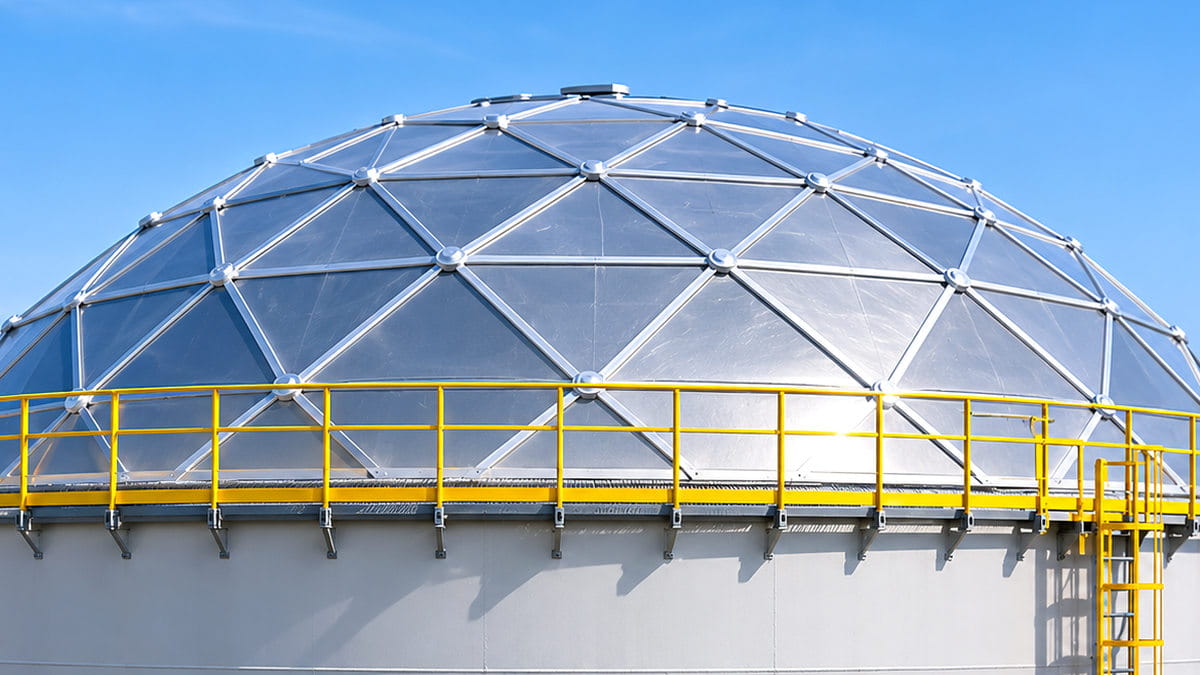
Why Are Aluminum Domes Used in Industrial Storage?
Industrial storage tanks are exposed to changing weather conditions and operational requirements.
Depending on the installation, these conditions may include rainfall, wind, solar radiation, temperature fluctuations and corrosive atmospheres.
A suitable roof system helps protect the tank and its contents from external exposure.
Protection Against Rainwater and External Contamination
An aluminum dome provides a fixed overhead enclosure that helps limit the direct entry of precipitation, dust and other external materials.
This can be particularly relevant in tanks equipped with floating roofs, where direct exposure to rainwater may create additional operational requirements.
Protective performance depends on the design of the panels, joints, openings and drainage arrangements.
A dome should not automatically be considered hermetically sealed.
Corrosion Resistance
Aluminum develops a naturally protective oxide layer that contributes to its corrosion resistance in many environments.
This can make aluminum attractive for exposed industrial structures.
However, corrosion resistance depends on the alloy, atmospheric conditions, contact with other materials and the presence of aggressive substances.
Coastal environments and chemically demanding installations may require additional precautions.
Lightweight Structural Design
One of the principal advantages of aluminum is its relatively low density compared with steel.
For storage tank roofs, this can help reduce structural dead load.
Nevertheless, overall structural performance depends on the complete dome geometry, supporting connections and applicable design loads.
A lightweight roof is not automatically suitable for an existing tank without engineering verification.
Key Benefits of Aluminum Geodesic Domes
Properly designed aluminum geodesic domes can offer several benefits for industrial storage operators.
Clear-Span Construction
Self-supporting designs can eliminate the need for internal roof-support columns, simplifying the space beneath the roof.
Weather Protection
The dome creates a permanent enclosure that shields compatible tank equipment from direct exposure to precipitation and wind.
Corrosion Resistance
Appropriate aluminum alloys can provide durable performance in suitable industrial environments.
Modular Construction
Structural members and roof panels can be manufactured as individual components for transport and assembly.
Retrofit Potential
Existing tanks may be candidates for dome installation following a structural assessment.
Floating Roof Integration
Dome structures can complement floating roof and rim-sealing arrangements in certain storage applications.
These benefits should be assessed against installation complexity, maintenance needs, regulatory requirements and the actual condition of the tank.
No roof system eliminates all operational or environmental risks.
Aluminum Domes and VOC Emission Control
Volatile organic compounds, commonly referred to as VOCs, can evaporate from stored petroleum products and certain industrial chemicals.
The environmental performance of a storage tank depends on its roof configuration, product characteristics and operating conditions.
An aluminum dome can contribute to emission management, particularly when it covers an existing external floating roof.
What Happens When a Floating Roof Tank Is Covered?
An external floating roof tank has a moving deck directly exposed to atmospheric conditions.
When a fixed dome is installed above the floating roof, the storage configuration changes.
The dome shields the floating deck from direct wind exposure.
According to the US Environmental Protection Agency's AP-42 guidance for organic liquid storage tanks, wind influences certain emissions associated with floating roof rim seals and deck fittings.
Covering the floating roof changes the wind-dependent components used in relevant emission calculations.
Does an Aluminum Dome Eliminate Vapor Emissions?
No.
A fixed dome is not necessarily a vapor-tight barrier.
Depending on the configuration, circulation vents and other openings may be required to manage the atmosphere beneath the roof.
Vapors may still escape through floating roof rim seals, deck fittings and other pathways.
The performance of a covered tank therefore depends on the complete system.
A project-specific emission assessment should consider the stored product, tank dimensions, roof type, seal condition, ventilation and operating conditions.
Important: Dome Roofs and VOC Emissions
An aluminum geodesic dome should not be considered a guarantee of zero VOC emissions.
The environmental performance of a storage tank must be evaluated according to its complete roof configuration, sealing systems, ventilation and operating conditions.
Combining Domes with Internal Floating Roofs
An internal floating roof moves with the liquid level beneath a fixed roof.
When combined with an aluminum dome, the two structures perform different functions.
The floating roof reduces the exposed liquid surface and the vapor space immediately above the product.
The dome provides a fixed protective enclosure.
Rim seals and deck-fitting controls address additional paths for vapor movement.
This combination can be relevant where environmental performance, weather protection and operational requirements justify an integrated solution.
Aluminum Dome Roof vs Steel Roof: Main Differences
Aluminum geodesic domes and conventional steel roofs can both be used in industrial storage applications.
However, their structural characteristics and maintenance requirements differ.
Aluminum Geodesic Dome
Lightweight construction, potential for clear-span design, corrosion resistance in suitable environments and modular assembly options.
Conventional Steel Roof
May use different structural configurations and internal supports. Corrosion protection and maintenance depend on coatings, materials and operating conditions.
Structural Weight and Support
Aluminum has a lower density than steel, although structural weight depends on the design and required member sizes.
A geodesic aluminum dome can be designed to span a circular tank without internal roof-support columns.
Some steel roof configurations also provide clear spans, while others use internal supports.
The comparison should therefore consider the actual roof systems rather than the materials alone.
Corrosion and Maintenance
Steel roofs may require protective coatings and ongoing corrosion management, depending on their environment.
Aluminum roofs can offer corrosion-resistance advantages in suitable applications, but they still need inspection.
Fasteners, connections, joints and interfaces between different metals remain important maintenance considerations.
Installation and Modification
Modular dome components can simplify certain transportation and assembly tasks.
However, a retrofit may require changes to the tank shell, roof attachments, vents or other components.
Installation planning should consider access, lifting requirements, site safety and operating restrictions.
Which Option Is Better?
There is no universal answer.
The appropriate choice depends on tank diameter, design loads, environmental conditions, compatibility, capital expenditure and lifecycle requirements.
A technical comparison should include both initial installation costs and expected inspection and maintenance needs.
Engineering Factors When Selecting Aluminum Domes
A geodesic roof must be designed around the conditions of the specific installation.
The following factors are particularly important.
1. Tank Diameter and Structural Condition
Tank dimensions determine the required dome geometry and the loads transferred through the structure.
For existing tanks, engineers must assess the condition and capacity of the supporting shell.
Previous modifications, corrosion or deformation may affect the suitability of the tank for a new roof.
2. Wind, Snow and Environmental Loads
An aluminum dome must withstand the loads specified for its installation.
These may include wind, snow, temperature effects and other environmental actions.
Where applicable, seismic requirements must also be considered.
The load combinations and structural verification depend on the governing design standards and location.
3. Perimeter Connections and Load Transfer
The dome transfers structural loads to the tank through its perimeter attachment system.
These connections must accommodate relevant forces and movements.
The assessment should address vertical loads, horizontal effects and the interaction between the dome and the tank shell.
Thermal expansion and structural movement can also influence attachment design.
4. Aluminum Alloys and Material Compatibility
The selected aluminum alloys must provide suitable mechanical and corrosion-resistance properties.
Engineers should also consider the compatibility of fasteners, connection materials and protective elements.
Where dissimilar metals are in contact, appropriate design measures may be needed to manage galvanic corrosion.
5. Ventilation and Safety
A fixed roof changes the environment above the stored product or floating deck.
Ventilation and pressure-related requirements must therefore be evaluated carefully.
Depending on the tank configuration, designers may need to consider vapor accumulation, hazardous atmospheres, ignition sources, emergency access and firefighting arrangements.
Installing a dome does not automatically improve every aspect of operational safety.
6. Applicable Standards
API 650 Annex G establishes requirements for structurally supported aluminum dome roofs when that framework applies to the project.
For European structural engineering, Eurocode 9 (EN 1999) addresses the design of aluminum structures, together with other relevant Eurocodes.
The applicable editions, national requirements and project specifications must be confirmed during design.
Reference to these standards does not, by itself, establish that a particular dome has been certified or approved.
Can Aluminum Domes Be Installed on Existing Storage Tanks?
Yes. Aluminum domes can be considered for retrofit projects, provided the existing tank is suitable for the proposed roof.
However, feasibility depends on structural capacity, operating conditions and the modifications required.
Step 1: Survey the Existing Tank
The engineering assessment should begin with reliable information about tank geometry, shell condition and existing equipment.
The inspection may identify structural limitations, access requirements or modifications needed before installation.
Step 2: Review Structural Capacity
The supporting shell and associated structures must be capable of accommodating the loads introduced by the dome.
The foundation may also need to be evaluated.
A lightweight design does not remove the need for these checks.
Step 3: Evaluate Existing Roof Equipment
If the tank has an external floating roof, engineers should examine the floating deck, rim seals, drainage systems and other equipment.
The new dome must be compatible with the normal operating range of the floating roof.
Step 4: Define Ventilation and Access
Ventilation openings, inspection access, maintenance routes and emergency arrangements should be included in the design.
These details may affect the operational suitability of the finished installation.
Step 5: Plan Assembly and Installation
Geodesic dome systems may be assembled using modular components.
The installation method depends on available space, lifting equipment, tank condition and site restrictions.
Some projects may permit work without a complete operational shutdown, but this cannot be assumed.
A project-specific safety assessment and installation plan are essential.
Step 6: Verify the Completed System
After installation, the structure should be inspected against its design documentation.
Checks may include connections, roof panels, sealing details, perimeter attachments and installed accessories.
The operator should also receive appropriate inspection and maintenance information.
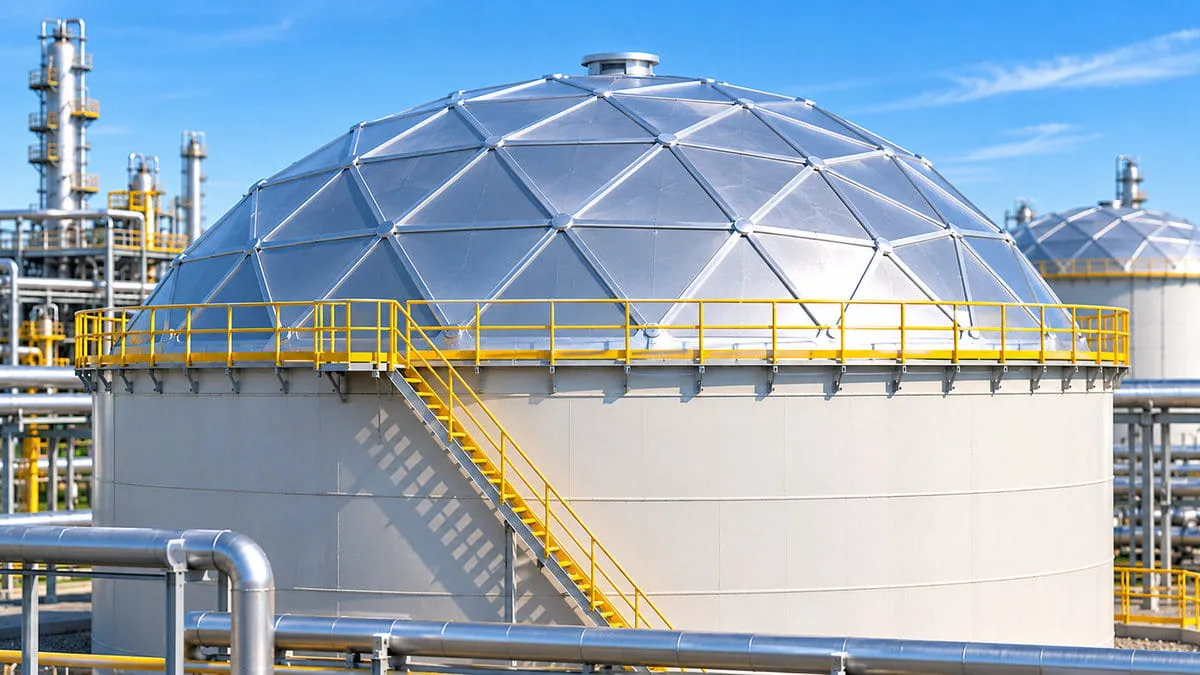
Aluminum Dome Maintenance and Inspection
Although aluminum domes may require less coating maintenance than some steel roof systems, they are not maintenance-free.
Inspection helps identify deterioration, damage and changes that could affect structural or operational performance.
What Should Be Inspected?
A maintenance program should consider:
- Structural members: signs of deformation, cracking or unusual movement.
- Connections and fasteners: loosening, damage and corrosion-related problems.
- Roof panels: distortion, impact damage or deterioration.
- Panel joints and sealing elements: water ingress or compromised connections.
- Perimeter supports: condition of the roof-to-tank attachment.
- Ventilation equipment: obstruction, deterioration or improper operation.
- Access components: condition of hatches, ladders and relevant safety equipment.
Inspection procedures and intervals should follow the manufacturer's documentation, applicable requirements and the facility's maintenance program.
Long-Term Performance
Environmental exposure, installation quality and operating conditions all influence service life.
The roof's performance must be assessed together with the condition of the supporting tank.
Operators should also review the system after significant events such as severe storms, structural impacts or major tank modifications.
Where Are Aluminum Domes Used?
The potential applications of aluminum domes extend across several industrial sectors.
Petroleum Storage
Refineries and tank terminals may use aluminum domes to protect compatible storage tanks and floating roof systems.
Chemical Facilities
Chemical storage applications require particular attention to material compatibility, ventilation and hazardous atmospheres.
Petrochemical Industry
Industrial storage installations may use geodesic aluminum roofs as part of their tank protection and operating infrastructure.
Water Infrastructure
Aluminum dome structures can also be considered for selected water storage and environmental engineering applications.
Petroleum Storage and Tank Terminals
Refineries and bulk-storage terminals may use aluminum domes to protect suitable tanks and floating roof equipment.
In these applications, the engineering assessment often includes emission management, stored product characteristics and compatibility with existing roof systems.
Chemical and Petrochemical Facilities
Chemical storage can require additional evaluation of material compatibility, ventilation and hazardous atmospheres.
The suitability of an aluminum dome depends on the chemicals stored and the conditions inside the tank.
Water and Environmental Infrastructure
Aluminum dome structures can also be considered for water-related storage and environmental facilities.
However, requirements for water quality, internal atmosphere, corrosion resistance and access may differ substantially from those of petroleum storage tanks.
Applications involving drinking water require compliance with the relevant hygiene and material requirements.
Each use should be evaluated separately.
TAC Enviro and TankDome Aluminum Geodesic Roofs
Among the companies developing industrial storage tank roofing systems is TAC Enviro, a Spanish engineering business supplying equipment for the petrochemical, water and environmental sectors.
Its product range includes TankDome, an aluminum geodesic dome solution designed for storage tank protection and operational efficiency.
TankDome Structural Design
According to TAC Enviro's published product information, TankDome uses a triangulated, self-supporting structure with aluminum beams and roof panels.
The company describes the system as suitable for new storage installations and certain retrofit projects.
Its design focuses on lightweight construction, structural strength and protection against environmental exposure.
The available configuration must nevertheless be evaluated against the actual tank conditions and applicable requirements.
Modular Assembly and Project Adaptation
TAC Enviro describes a modular arrangement intended to facilitate transportation and assembly.
This approach may provide practical advantages for projects with specific access, logistics or installation constraints.
However, the feasibility of installation without interrupting tank operations depends on the project and must be confirmed during planning.
Complementary Storage Technologies
TAC Enviro also develops floating roof and sealing technologies.
These include TankPontoon and TankContact floating roof systems and the TankSeal range of primary and secondary seals.
Such products address different requirements within the storage tank.
A dome protects and covers the tank, a floating roof reduces the exposed liquid surface, and a rim seal helps control vapor movement between the floating roof and tank shell.
For projects involving several technologies, the components must be engineered as a compatible system.
Additional information is available on the TankDome aluminum geodesic dome solutions developed by TAC Enviro.
Choosing Aluminum Domes for Long-Term Storage Performance
Aluminum domes offer a practical roofing option for suitable industrial storage tanks, combining lightweight structural design with weather protection and the possibility of integration with floating roof systems.
Their performance depends on the correct assessment of loads, materials, structural connections, ventilation and operating conditions.
For engineering teams considering aluminum domes, the priority should be a detailed evaluation of the existing or proposed tank, applicable standards and long-term maintenance requirements.
TAC Enviro provides information about its TankDome systems for industrial operators and contractors evaluating new storage roofs or retrofit projects.
A technical review of the tank configuration is the appropriate starting point for determining whether a geodesic aluminum dome is a suitable solution.
Explore TAC Enviro's TankDome Solutions
Discover TAC Enviro's aluminum geodesic dome systems for industrial storage tanks, including new installations and potential retrofit applications.
Explore structural design features, installation considerations and complementary storage technologies.
Explore TAC Enviro TankDome SystemsFrequently Asked Questions About Aluminum Domes
What are aluminum domes used for?
Aluminum domes are used as protective roof structures over compatible industrial storage tanks. They provide an overhead enclosure and may be combined with floating roofs and sealing systems.
What is an aluminum geodesic dome?
An aluminum geodesic dome is a curved roof structure made from interconnected triangular aluminum members and attached panels. Its geometry allows structural loads to be distributed toward the supporting perimeter.
Are aluminum domes self-supporting?
Many industrial geodesic aluminum domes are designed to be self-supporting from the tank perimeter without internal roof-support columns. The supporting tank must be verified for the required loads.
Can aluminum domes reduce VOC emissions?
In certain floating roof tank configurations, a dome can help reduce wind-related vapor losses. The actual effect depends on the floating roof, seals, deck fittings, product and operating conditions. A dome alone is not necessarily vapor-tight.
Can aluminum domes be installed on existing tanks?
Yes, retrofit installation may be possible after assessment of tank geometry, structural capacity, roof equipment, ventilation and installation conditions.
What is the difference between an aluminum dome and an internal floating roof?
An aluminum dome is a fixed overhead roof. An internal floating roof moves vertically with the liquid level beneath a fixed roof to reduce the exposed liquid surface. The two systems have different functions and can be used together.
Are aluminum dome roofs better than steel roofs?
Each option has advantages and limitations. Aluminum domes can offer low weight, corrosion resistance and clear-span construction, while other roof designs may suit different structural and economic requirements.
Which standards apply to aluminum geodesic domes?
API 650 Annex G addresses structurally supported aluminum dome roofs when applicable. Eurocode 9 provides structural design requirements for aluminum structures in relevant European projects. Local rules and project specifications must also be considered.
Do aluminum domes require maintenance?
Yes. Structural members, fasteners, panels, perimeter connections, sealing details and ventilation equipment require appropriate inspection and maintenance.
Technical References
Further information about emissions from industrial storage tanks is available in the US EPA AP-42 guidance on organic liquid storage tanks.
For structural design requirements concerning aluminum structures, consult the European Commission's Eurocode 9 information.
Additional information about storage tank design standards is published by the American Petroleum Institute.
Technical note: This article provides general engineering information and is not a certified design specification, installation procedure or regulatory compliance assessment. Dome design, retrofit feasibility and tank safety must be evaluated by qualified professionals using applicable standards, project-specific documentation and site safety requirements.


SÍGUENOS


